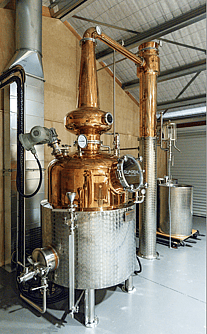
When people think about distilling, it’s often imagined as a simple process. Heat a liquid, collect what comes out, and you have gin. In reality, it’s a far more deliberate and carefully controlled journey, where every stage plays a role in shaping the final spirit.
At Ruapehu Distillery, that journey happens inside Nigella, our 500L copper pot still, and it begins well before the still is even switched on.
Building the Foundation: Maceration
Before distillation begins, juniper and coriander, the backbone of our gin, are macerated in alcohol for 24 hours. This stage allows the botanicals to slowly release their essential oils, creating a base layer of flavour that will carry through the entire run.
This slower approach builds depth and structure, ensuring the spirit already has character before it ever becomes vapour.
Bringing the Still to Life
As Nigella heats up, the process unfolds gradually. Alcohol begins to evaporate at a lower temperature than water, which means the first movement inside the still is subtle rather than dramatic. Over time, vapour begins to rise, carrying with it the flavours extracted during maceration.
Lifting the Aromatics: The Sieve Plate
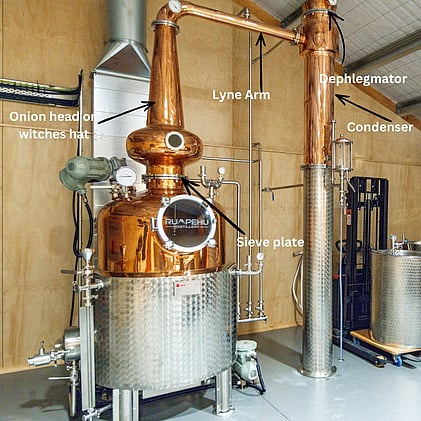
From there, the vapour moves through a sieve plate, rather than a traditional gin basket.
Botanicals placed on the sieve plate are not submerged in liquid. Instead, the rising vapour passes through them, gently extracting lighter, more delicate aromatic compounds. This vapour distillation method adds lift and complexity, complementing the deeper flavours already built during maceration.
Refining the Spirit: The Role of the Dephlegmator
As vapour rises through Nigella, it passes through a dephlegmator, which plays a key role in refining the spirit.
As the liquid heats, vapour begins to rise and carrying flavour with it.
From there, the vapour continues upward into the onion head (or “witches hat”), where it expands and begins to move across the lyne arm.
At this point, the vapour reaches the dephlegmator.
Here, a portion of the vapour is cooled just enough to condense and fall back into the still. This creates reflux, effectively giving the spirit another pass at refinement before it continues on. Heavier compounds are returned to the pot, while lighter, cleaner vapours carry forward. The result is a cleaner and more controlled spirit.
Condensing the Spirit: The Role of Cold Water
Once the vapour has travelled up the pot, passing the sieve plates, up the "witches hat" and across the lyne arm, it enters the condenser, where it is cooled and returned to liquid form.
At Ruapehu Distillery, this cooling is driven by alpine rain water sourced from a 10,000-litre tank outside the distillery. Thanks to Ohakune’s consistently colder climate, particularly at night, the water remains naturally chilled, allowing for efficient condensation without excessive energy use.
The water is then reticulated back into the tank and reused, creating a continuous cooling cycle that reflects both the environment we operate in and a practical approach to resource use.
The Cut: Selecting the Best Part of the Run
Not everything that comes off the still is destined for the bottle.
The early portion of the run, known as the heads, contains sharper compounds, while the later portion, the tails, carries heavier, less refined characteristics. Between these sits the hearts; the clean, balanced spirit that defines the final product.
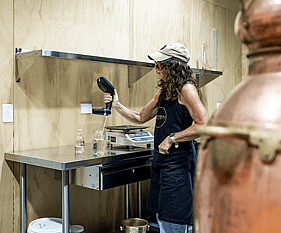
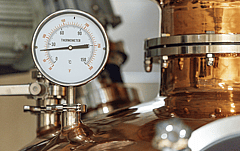
Selecting this cut is one of the most important decisions in the process and relies on sensory judgement rather than automation. There's some science involved and rigorous measurement of still and distillate temperatures, and alcohol by volume (ABV).
From Still to Glass
A full distillation run takes time, patience, and attention to detail. From maceration through to the final cut, each stage contributes to the overall balance and character of the spirit.
What ends up in the glass is not simply the result of ingredients, but of a carefully managed and intentional process. One that brings together technique, equipment, and the unique conditions of Ohakune.
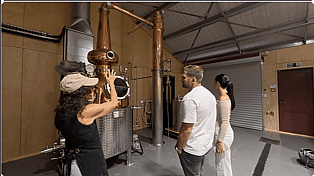
Experience It for Yourself
Reading about the process offers insight, but seeing Nigella is something else entirely.
If you’d like to experience a behind-the-scenes distillation process up close, you can book a distillery tour and step inside the working distillery. You can also experience a guided tasting of Straight Up Carrot Gin, and taste the result of that journey for yourself.